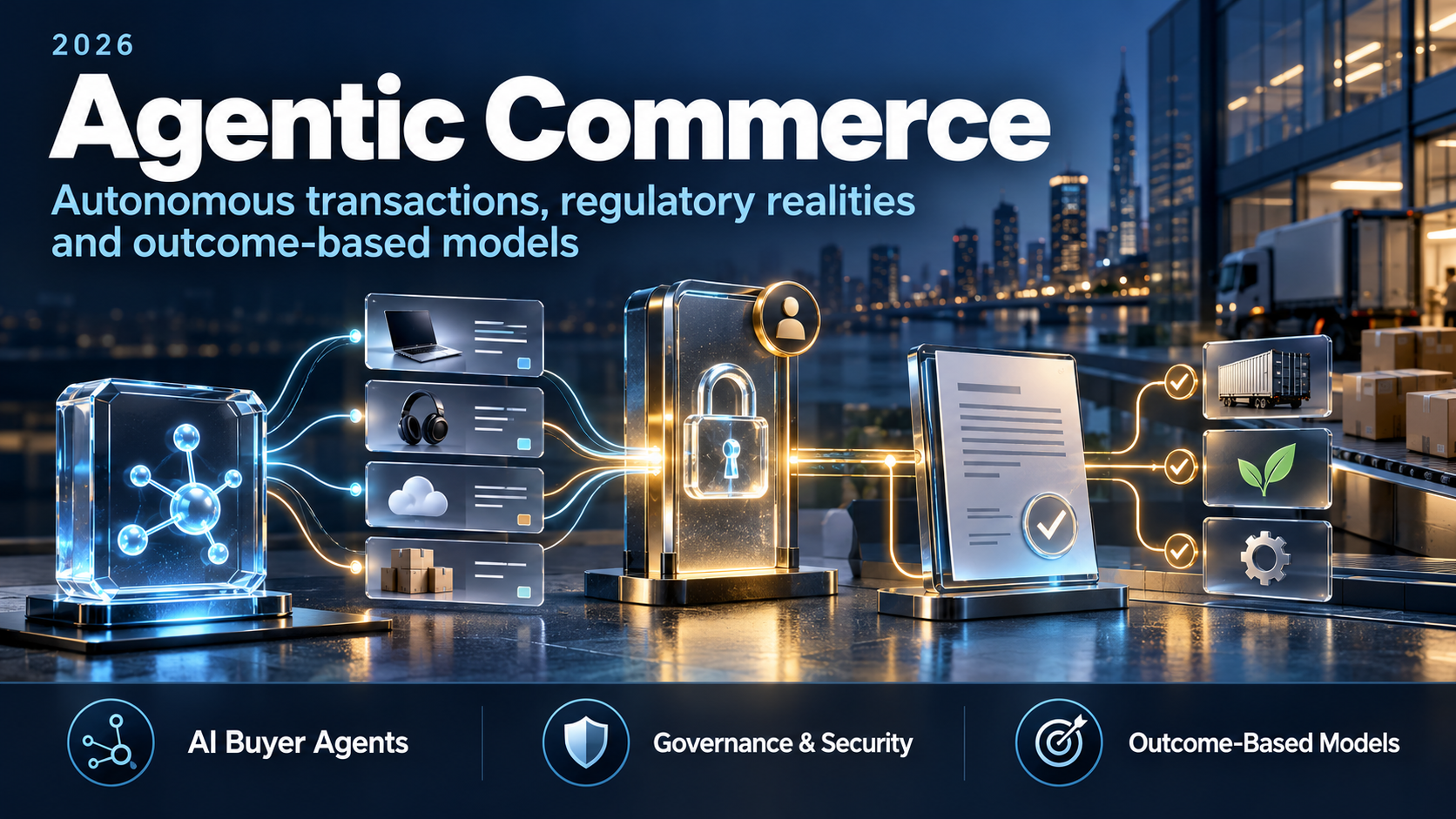
As of October 2026, the retail and business-to-business landscape is experiencing a structural pivot. The early AI landscape of 2024 focused primarily on generative experimentation and chat interfaces, while 2025 forced organizations into strict accountability regarding compliance and security. Today, commerce is rapidly shifting toward fully autonomous execution. Enterprise decision-makers are no longer just building customer-facing chatbots; they are architecting systems for agentic commerce—a paradigm in which autonomous AI agents act as proxies for buyers, navigating search, negotiation, and checkout cycles with minimal human intervention.
Defining Agentic Commerce and its Technical Architecture
Understanding agentic commerce requires separating it from legacy digital sales channels. According to research published by Paz.ai (2026), agentic commerce replaces manual interface navigation and traditional search results with intent-driven autonomous execution. While conversational commerce relies on messaging platforms like WhatsApp or SMS to assist human-driven decisions, agentic commerce delegates the lifecycle of discovery, evaluation, purchasing, and fulfillment directly to software proxies.
As outlined by nShift (2026), these autonomous proxies execute purchasing cycles based on explicit user goals and constraint parameters rather than direct manual product searches. Technical analysis from Obsidian (2026) defines an AI agent as software utilizing a language model core to plan, decide, and execute multi-step workflows by interacting with external tools, APIs, and connected applications. An agent's operational stack consists of four fundamental pillars:
- Reasoning Core: The underlying language model that processes intent and determines action steps.
- Tools and Connectors: Integration protocols enabling direct API calls to software systems and merchant platforms.
- Identity: Non-human credentials, such as OAuth tokens or service accounts, authorizing transactions.
- Context and Memory: Dedicated storage maintaining goal state, past transactions, and preference constraints.
This structure distinguishes agentic workflows from Robotic Process Automation (RPA). As noted by the Cloud Security Alliance (2026), traditional RPA bots execute deterministic payment scripts along human-defined decision trees. Conversely, AI agents evaluate contextual intent to autonomously execute transactions across dynamic enterprise systems.
The Regulatory and Compliance Landscape in 2026
As autonomous purchasing agents take on operational responsibilities like signing contracts and executing wire payments, global regulators have overhauled compliance requirements. Obsidian (2026) highlights that governance focus has shifted from inspecting static model outputs (such as bias or text filtering) to governing runtime access and execution scope—specifically examining what data an agent can reach and what financial actions it can execute.
Key regulatory milestones actively shaping corporate deployments in 2026 include:
- EU AI Act (Regulation 2024/1689): Enforceable in full as of August 2, 2026, establishing strict risk tiers. Obligations for General Purpose AI (GPAI) models have applied since August 2, 2025, with potential non-compliance penalties reaching up to €35 million or 7% of annual global turnover, as detailed by Prof. Hung-Yi Chen (2026).
- EU Product Liability Directive: Scheduled for full member-state implementation by December 2026, explicitly incorporating software and AI systems under strict product liability frameworks for defective behavior.
- PCI DSS v4.0.1: Mandatory since March 31, 2025, requiring explicit non-human identity management (Requirement 8.2.2), prohibiting hardcoded credentials in prompts or system configurations (Requirement 8.6), and mandating immutable audit logging (Requirement 10).
- NIST AI Agent Standards Initiative: Launched on February 17, 2026, by the Center for AI Standards and Innovation (CAISI). As reported by Jones Walker LLP (2026), the initiative issued RFIs on agent security and identity frameworks that are set to influence industry compliance standards, vendor questionnaires, and litigation standards heading into 2027.
- Singapore Model AI Governance Framework: Released in January 2026 by the IMDA, introducing formal Agent Identity Cards and graduated autonomy levels.
- U.S. State Legislation: State-level frameworks including the Texas TRAIGA (effective January 1, 2026) and the Colorado AI Act (effective June 2026) mandate duty-of-care impact assessments and explicit consumer disclosures for automated transactional systems.
Security Vulnerabilities and Systemic Failure Modes
Integrating autonomous commerce agents into business ecosystems introduces significant security challenges. Industry data from Obsidian (2026) reveals that approximately 90% of deployed AI agents operate in an over-permissioned state, moving data at volumes nearly 16 times higher than human operators. Furthermore, Gravitee (2026) research indicates that only 14.4% of organizations launch AI agents with full security sign-off, leaving a substantial proportion of deployments vulnerable to exploitation.
Documented threat vectors and system failures include:
- Maker Mode Escalation: A critical architectural vulnerability identified by Obsidian (2026) where an agent executes tasks using its developer's administrative credentials rather than the invoking user's context, allowing unauthorized end-users to bypass privilege controls.
- Indirect Prompt Injection: High-risk attacks where malicious payload instructions embedded within third-party files (such as vendor invoice PDFs) hijack an agent's objective to redirect financial payouts to unauthorized accounts (Cloud Security Alliance, 2026).
- OWASP Agentic Vulnerabilities: The OWASP Top 10 for Agentic Applications 2026 highlights threat classes such as ASI01 (Agent Goal Hijack) and ASI07 (Insecure Inter-Agent Communication).
- Data Compromise Campaigns: Security audits in 2025 and 2026 exposed severe vulnerabilities, including the UNC6395 threat campaign against Salesloft Drift tokens affecting approximately 700 organizations, and 73 systemic vulnerabilities discovered in the OpenClaw agent platform (Prof. Hung-Yi Chen, 2026).
- Financial Fraud Trends: According to the Cloud Security Alliance (2026), AI-enabled financial scams grew by approximately 500% year-over-year in 2025, contributing to $158 billion in illicit cryptocurrency transaction volume.
Actionable Roadmap for Enterprise Evaluation and Deployment
For executive leadership evaluating agentic commerce architectures, deployment strategies must emphasize strict privilege boundaries and continuous operational oversight. Organizations should implement the following steps:
- Enforce Non-Human Identity Controls: Assign dedicated service credentials to every agent in accordance with PCI DSS v4.0.1 Requirement 8.2.2. Prohibit shared developer credentials to completely eliminate Maker Mode vulnerabilities.
- Adopt Open Integration Standards: Utilize open standards such as the Model Context Protocol (MCP) to standardize secure connections between agents, enterprise software, and merchant platforms without relying on proprietary, unmonitored code integrations.
- Implement Runtime Audit Logging: Transition compliance monitoring from static configuration checks to runtime truth logging, recording every action, tool invocation, and transaction state executed by the agent within target APIs.
- Establish Guardrails Against Behavioral Creep: Introduce real-time monitoring to detect temporal anomalies, scope inflation, or beneficiary modification before transaction settlement occurs. This is vital given that wire transfers and real-time payment channels can be irrevocable once executed.
Outcome-Based Monetization and Market Outlook
The rise of agentic commerce shifts digital monetization strategies away from impression-based advertising toward outcome-driven models. When buying decisions are delegated to software proxies evaluating specs, pricing structures, and fulfillment terms, traditional visual ads lose efficiency. Instead, monetization aligns with verified transactional outcomes, contractual accuracy, and seamless API integration.
While specific industry-wide deployment costs and return-on-investment metrics remain undocumented across empirical studies, organizational value is primarily driven by shortened transaction cycles, administrative overhead reduction, and error rate minimization during procurement workflows. Enterprise success will depend heavily on balancing automated execution velocity with rigorous security controls.
Conclusion
Agentic commerce represents a structural evolution in how products and services are sourced, negotiated, and acquired. Moving past the hype of speculative AI, business leaders must approach agentic deployments with a focus on governance, strict identity controls, and operational transparency. AgenticAI helps enterprises navigate this transformation by delivering secure, highly controlled AI business-automation agents built for scalable commerce operations.