The Shift in Enterprise AI Architecture
As of October 2026, enterprise artificial intelligence has moved beyond basic conversational interfaces into full agentic automation. Organizations are no longer satisfied with isolated prompt engineering; they require autonomous agents capable of performing multi-step tasks across complex operational workflows. Enterprise software architectures now treat traditional AI, machine learning, large language models (LLMs), generative AI, and agentic AI as a structured, layered technological stack where each technology builds upon the foundational capabilities of the previous layer, according to an architectural guide by Galileo AI (2026).
This structural evolution is reflected in rapid corporate adoption. Gartner projects that 40% of enterprise applications will feature task-specific AI agents by the end of 2026, representing a dramatic shift from less than 5% in 2025, as reported by Galileo AI (2026). However, as leadership teams integrate these agents into core operations, they face a pivotal architectural choice: Should they continuously fine-tune and train custom internal models, or should they implement an agentic framework that pairs Retrieval-Augmented Generation (RAG) with multi-layered contextual memory?
Defining the Components: RAG and Contextual Memory
To evaluate these architectural approaches, decision-makers must understand the technical distinction between stateless context retrieval and stateful memory persistence. Standard Retrieval-Augmented Generation (RAG) operates as a stateless architecture. It retrieves relevant document fragments at query time from an external index to ground an LLM's responses in real time without necessitating continuous model retraining, as outlined in an enterprise analysis by Squirro (2026). Because traditional RAG is inherently stateless, its operational context resets completely at the end of each user session.
In contrast, Contextual Memory—often referred to as agentic or long-context memory—is a stateful technology. It enables LLMs to store, persist, and access pertinent information across multiple interaction turns, sessions, and workflows, driving long-term continuity and personalization, according to research published by Atlan (2026).
The Three-Layer Memory Architecture
To deliver true operational autonomy, modern agentic systems employ a structured, three-layer memory architecture, as detailed in an enterprise architecture report by Innoflexion (2026):
- Episodic Memory: A temporally indexed interaction history that tracks what actions were taken, when they occurred, and what immediate results were generated across user sessions.
- Semantic Memory: A distilled and continually updated representation of knowledge, including domain facts, enterprise entities, and contextual relationships.
- Procedural Memory: A repository of learned task patterns, workflow sequences, and tool execution routines that dictate how the agent solves specific operational problems over time.
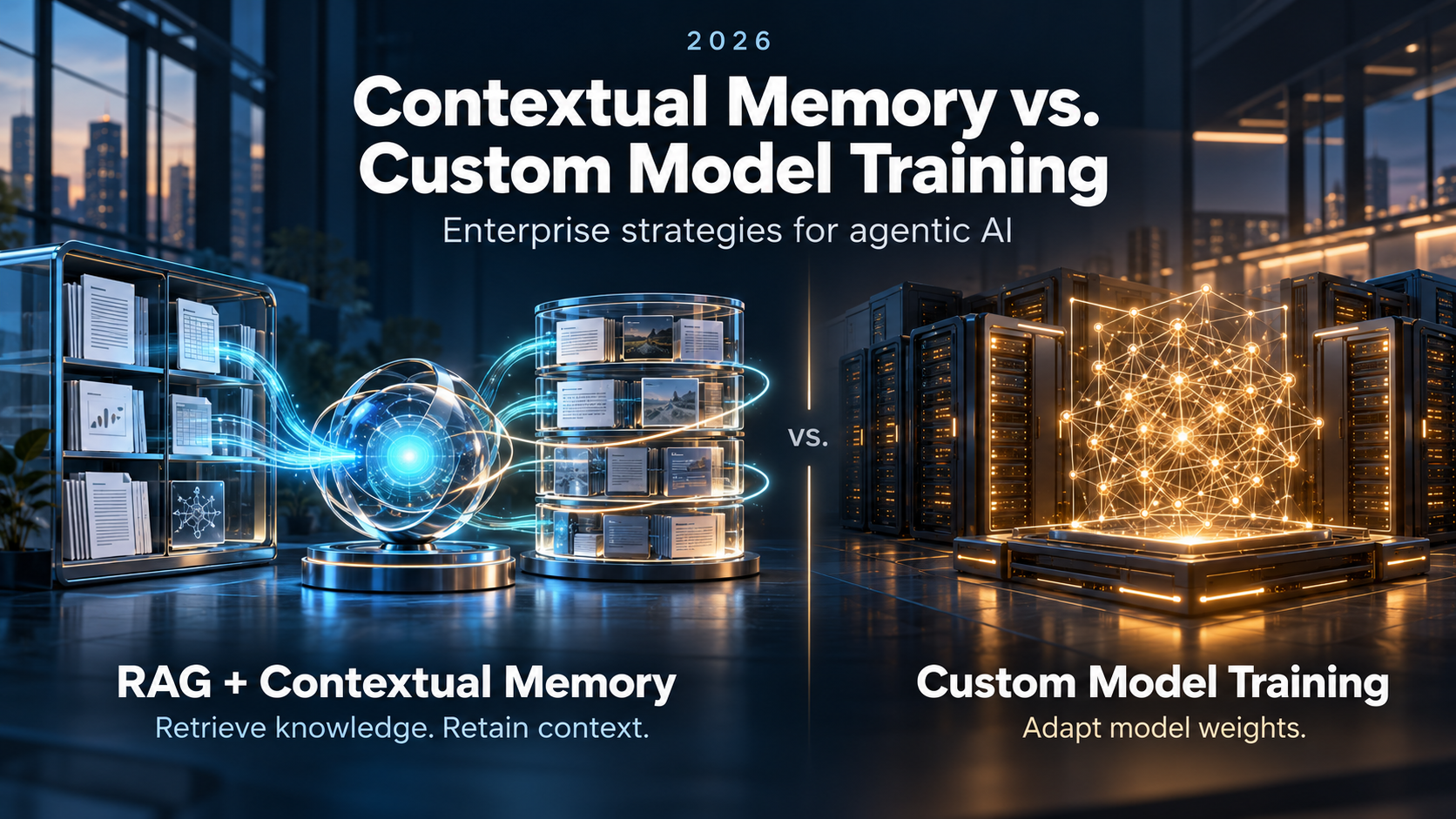
RAG with Contextual Memory vs. Custom Model Training
When organizations evaluate how to domain-adapt AI agents, fine-tuning medium-sized or proprietary LLMs is frequently considered. However, custom model training presents distinct operational and financial trade-offs. Fine-tuning medium-sized models can require substantial GPU compute resources, extended training cycles, and specialized talent to manage model weights and prevent catastrophic forgetting, as highlighted by Galileo AI (2026).
Furthermore, model training creates static knowledge snapshots. Once training is complete, the model's internal parameters cannot reflect real-time enterprise data changes without undergoing additional, expensive compute cycles. While custom model training can adjust an LLM's tone, syntax, or highly specialized domain language, it remains inefficient as a primary mechanism for dynamic enterprise knowledge management.
Conversely, combining RAG with stateful contextual memory isolates enterprise knowledge and operational history from the underlying foundation model. The external RAG index provides real-time access to authoritative documents, while the contextual memory layers allow the agent to track user preferences, ongoing task states, and procedural history across sessions. This decoupled architecture allows organizations to upgrade underlying foundation LLMs without losing their persistent organizational memory or re-indexing entire knowledge bases.
Evaluating the Operational Trade-offs
| Dimension | Stateless RAG | RAG + Contextual Memory | Custom Model Training (Fine-Tuning) |
|---|---|---|---|
| Statefulness | Stateless (resets per session) | Stateful (persists across sessions) | Stateless during inference |
| Resource & GPU Overhead | Low (vector indexing & retrieval) | Moderate (memory distillation & indexing) | Substantial GPU compute and training time |
| Knowledge Freshness | Real-time index updates | Real-time facts + updated interaction history | Static snapshot until retraining |
| Personalization & Adaptation | Limited to current prompt context | High (tracks procedural and episodic state) | Fixed to dataset attributes |
Actionable Implementation Framework for Managers
For executive teams assessing their AI infrastructure roadmap in late 2026, the following step-by-step framework provides a structured evaluation path:
- Assess Data Volatility and Task Continuity: Determine whether your workflow requires persistent user state and dynamic data updates. If tasks span multiple sessions and rely on rapidly changing enterprise information, prioritize a stateful RAG and memory architecture over custom model fine-tuning.
- Audit Tool and Workflow Requirements: Determine if agents require procedural memory to execute multi-step tool calls. Standardize procedural templates so agents can retrieve standardized execution sequences without retraining base model parameters.
- Establish Resource and GPU Allocation Limits: Quantify the total cost of ownership (TCO). Factor in the ongoing GPU overhead and engineering overhead associated with custom model training compared to the vector storage and memory management costs of agentic memory systems.
- Implement Pilot Testing with Stateful Frameworks: Deploy a bounded pilot utilizing a three-layer memory structure (episodic, semantic, procedural) combined with real-time retrieval before making capital commitments to custom model training.
Governance, Compliance, and AgentOps Requirements
While agentic AI unlocks unprecedented operational efficiency, governance remains a major challenge. Deloitte reports that while 85% of companies expect to customize autonomous AI agents for their specific business needs, only 1 in 5 (20%) currently possesses a mature governance model to manage them, as cited by Galileo AI (2026).
Because agentic AI systems make non-deterministic decisions and execute tools independently, standard software monitoring is insufficient. Enterprise deployments require AgentOps (Agent Operations)—a dedicated framework of tools designed to monitor an AI's synthetic "brain" and decision-making processes in real time, according to an analysis by Red Hat (2026).
Managing stateful memory introduces additional regulatory and compliance considerations. Systems storing episodic and semantic interaction data across sessions must incorporate strict data hygiene protocols, including enterprise role-based access control (RBAC), automated memory pruning, and complete audit trails to comply with global data protection standards.
Strategic Outlook
In 2026, the combination of stateless RAG and stateful contextual memory offers enterprise leaders a highly flexible, scalable, and cost-efficient path toward agentic automation. By decoupling enterprise knowledge and operational context from foundation model weights, organizations avoid the significant GPU requirements and static limitations of custom model fine-tuning while retaining full control over persistent agent memory and real-time data grounding.
At AgenticAI, we assist enterprise teams in designing and deploying robust, governance-ready agentic architectures that leverage advanced contextual memory systems to automate complex business processes safely and effectively.