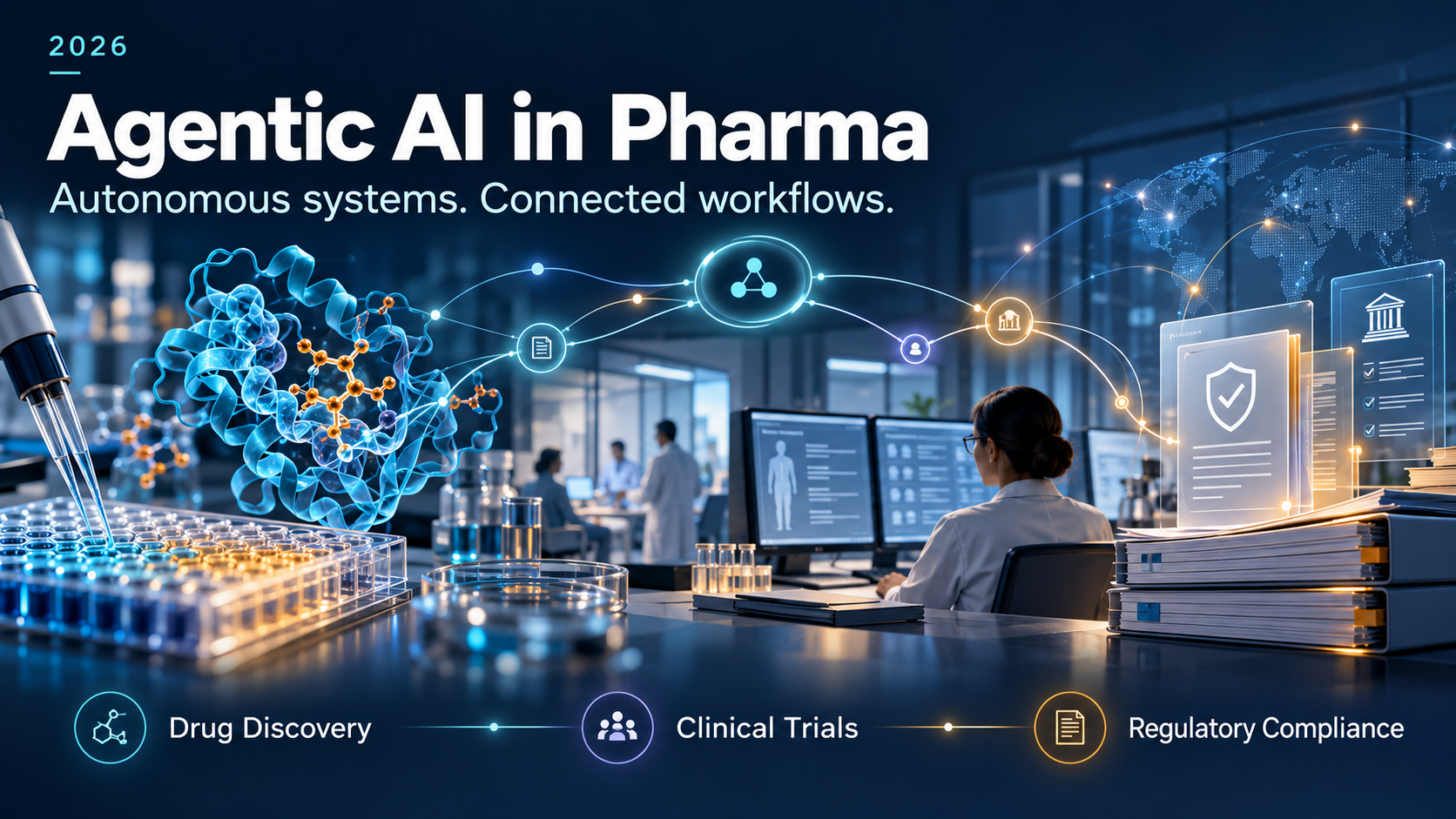
As of October 2026, the life sciences industry has passed a clear inflection point, moving beyond isolated AI pilots into full-scale operational integration. For years, pharmaceutical companies leveraged traditional machine learning models primarily as static prediction engines—predicting compound toxicity or identifying potential targets through passive computation. Today, that dynamic has fundamentally transformed. Biopharma organizations are increasingly adopting agentic artificial intelligence: autonomous systems designed to execute complex, multi-step workflows across drug discovery, clinical trials, and regulatory compliance with minimal human intervention.
The Paradigm Shift: From Oracle Models to Autonomous Digital Co-Workers
The transition to agentic AI represents a fundamental architectural and strategic shift in how biopharma enterprises manage technical workflows. According to analysis published by Vector Labs (2026), the industry is witnessing a clear movement away from the traditional "Oracle" model—wherein human operators ask a software tool a single question and receive a static prediction—toward an "Agent" model. In this new paradigm, human managers provide high-level objectives, and the autonomous AI agent independently plans, reasons, and executes the necessary multi-step tasks to achieve that goal.
Unlike legacy machine learning tools that only produce isolated risk scores or predictions, agentic systems proactively interact with external environments. As highlighted by Vector Labs (2026), these agents dynamically utilize external tools, including molecular simulators, database queries, and document generators, to orchestrate complex operations. By reasoning through intermediate steps and adjusting actions based on real-time feedback, agentic systems overcome the linear constraints of earlier computational biology platforms.
This shift alters the structural role of artificial intelligence within pharmaceutical research and development teams. As reported by PharmExec (2026), AI agents are transitioning from passive digital tools into active collaborators and full-fledged co-workers. These autonomous entities now independently synthesize massive datasets, formulate novel hypotheses, manage end-to-end operational workflows, and even direct physical laboratory equipment in closed-loop experimental environments.
Key Enterprise Use Cases across the Life Sciences Value Chain
Agentic AI architecture impacts three major functional pillars within modern biopharma enterprise operations:
1. Drug Discovery and Closed-Loop Experimentation
In early-stage research, agentic AI systems go far beyond predicting binding affinity or toxicity parameters. According to PharmExec (2026), agents can autonomously synthesize massive biomedical datasets, generate viable hypothesis candidates, and orchestrate physical laboratory experiments in a closed loop. When integrated with automated wet labs, an agentic system can run a computer simulation using molecular simulators, evaluate the result, instruct robotic lab systems to run physical assays, analyze the output database queries, and refine its next iteration without requiring continuous human re-prompting.
2. Clinical Trial Management and Orchestration
Clinical trials require navigating vast data streams, protocol adjustments, patient monitoring requirements, and complex logistics. Agentic AI platforms manage these multi-step processes by dynamically querying clinical databases, monitoring trial integrity, identifying operational anomalies, and organizing trial documentation across global sites, drastically reducing administrative drag for clinical operations managers.
3. Regulatory Filings and Compliance Automation
Regulatory submissions are inherently multi-step, document-intensive processes demanding rigorous accuracy and strict adherence to guidance. Rather than using basic text generation tools, biopharma regulatory teams utilize agentic systems that autonomously gather evidence, query internal empirical repositories, execute document generators, and format compliant submission dossiers. By managing document generation within an integrated reasoning loop (Vector Labs, 2026), agents ensure that every drafted section is backed by verified trial data and molecular results.
Evaluating and Implementing Agentic AI: A Strategic Framework
For executive teams and decision-makers evaluating agentic AI adoption in late 2026, transitioning from static software models to autonomous workflows requires deliberate planning. Below are concrete, actionable steps to guide implementation:
- Identify Bottlenecks Involving External Tool Orchestration: Map operational processes that require humans to bridge disconnected software—such as moving data manually from database queries to molecular simulators or document generators. These multi-tool touchpoints represent prime candidates for agentic automation.
- Transition from Single-Prompting to Goal-Based Architectures: Reframe internal engineering and workflow requirements. Instead of designing prompts that ask for single outputs, build system architectures around high-level objectives, granting agents access to designated tools and API interfaces.
- Establish Tool-Level Access and Integration Boundaries: Ensure that agents have clear, secure integration points with existing enterprise toolkits, including molecular modeling platforms, clinical databases, and automated documentation templates.
- Implement Human-in-the-Loop Operational Checkpoints: Maintain rigorous oversight by defining decision thresholds where an agent must pause autonomous execution and seek human approval—specifically when transitioning from computational hypothesis generation to physical experimentation or final regulatory filing.
Risks, Governance, and Compliance Requirements
While agentic AI offers significant throughput improvements, introducing autonomous systems into highly regulated biopharma environments presents distinct risk management challenges that executives must address:
- Deterministic Oversight vs. Autonomous Reasoning: Regulatory agencies demand full traceability. Because agentic systems dynamically choose tools and plan multi-step paths (Vector Labs, 2026), organizations must log every internal reasoning step, database query, and tool execution to guarantee complete auditability.
- Validation of Autonomous Closed-Loop Systems: When agents orchestrate physical experiments or synthesize scientific hypotheses autonomously (PharmExec, 2026), biopharma safety teams must implement rigorous validation protocols to prevent systematic error propagation or unsafe physical laboratory executions.
- Data Governance and Tool Interaction Integrity: Equipping agents with direct access to document generators and database systems requires robust role-based access control (RBAC) to ensure confidential scientific research and sensitive patient information remain fully protected.
Conclusion
By late 2026, agentic AI has redefine biopharma operational capabilities, shifting software from a passive query tool into an active, collaborative engine capable of planning and executing end-to-end scientific and regulatory workflows. Organizations that successfully adopt goal-driven agent architectures, provide robust tool integration, and establish transparent governance models will lead the next decade of therapeutic innovation. At AgenticAI, we assist enterprise teams across industries in designing, deploying, and governing custom AI agents to automate complex, high-value business processes seamlessly.